
Egypt’s gateway to the global economy
The Suez Canal Economic Zone
The Suez Canal Economic Zone (SCZone) is a central component of Egypt’s economic strategy and is considered one of the country’s most important development projects. The zone is intended to use Egypt’s location between Europe, Asia and Africa not only for transit trade, but also as a magnet for international manufacturing, logistics and technology.
The morning sun breaks through the haze over the Suez Canal – a 193-kilometer-long bottleneck through which around ten percent of global trade passes. While giant containers slowly glide through the waterway, there is a lot of activity on both banks. Here, between Sokhna on the Red Sea and Port Said on the Mediterranean, something is being built that Egypt’s government describes as the “new engine of the economy”: the Suez Canal Economic Zone (SCZone) – a mega-project covering an area of around 461 square kilometers that puts Egypt in the focus of the international economy. What used to be desert is now a landscape of harbor cranes, factory halls and new industrial parks. In Sokhna, Chinese, European and Arab companies work side by side. Textile factories, solar module plants, logistics centres – they all benefit from a location that is located directly at the eye of the needle of globalisation.
“In a world of increasingly fragmented supply chains, location diversification is becoming strategic. If you want to make production capacities resilient today, you should not only look at Eastern Europe – but also seriously examine what role Egypt can play in this,” says Yusef Ahmed in an interview with the Board Journal. The management consultant, who comes from Germany and is based in Egypt, supports companies from all over the world in setting up locations and business locally.
A special economic zone with a geopolitical mandate
The SCZone was created to strengthen Egypt’s role in global supply chains – not only as a transit country, but as a production location. It includes six seaports and four industrial and logistics zones , and operates with special tax and regulatory regimes to attract investors. The strategy is clear: foreign companies should not only smuggle goods through here, but also produce, assemble and export. For a country with a chronic shortage of foreign currency, this is a geopolitical project.
Billions of euros in investments – and thousands of new jobs
The figures are impressive – and politically intended.
- In the past three and a half years alone, 383 investment contracts have been concluded, with a total volume of 14.21 billion US dollars.
- These projects created around 134,300 direct jobs.
- In the first half of the 2025/26 financial year alone, 80 new projects worth over 5.1 billion US dollars were signed.
As of 2022/23, the projects add up to over 334 projects worth more than $10.4 billion, most of which are located in industrial parks and logistics centers. These figures make SCZone one of Africa’s largest industrial investment clusters.
“A significant part of the industrial space has already been allocated to international investors. This shows how dynamically the location is developing – and that strategic decisions should not be postponed at will,” explains Ahmed.
Opportunities and advantages for international companies
For international investors, SCZone offers a package of financial, tax and administrative benefits that go beyond the Egyptian average:
- Tariff advantages: 0% customs duty on imports and intermediate consumption for projects in the zone – including imports from within the country.
- Tax advantages: 0% VAT on procurements and operating goods in the context of production. In addition, companies benefit from a 50% reduction in income tax for up to seven years.
- No restrictions on repatriation of profits: 100% of profits can be transferred abroad.
- 100% foreign ownership of companies in the zone is allowed.
- Goods from the SCZone receive an Egyptian certificate of origin, which facilitates access to countries with which Egypt has free trade agreements (e.g. GAFTA, EU Association Agreements).
- There is a one-stop-shop structure that centrally coordinates company registration, customs declarations, licenses and regulatory approvals.
- Land use: Land can be allocated on a long-term basis (up to 50 years, extendable) with rights of use.
Subsidies and additional incentives
In addition to standard incentives for companies, SCZone itself has the right to provide additional support – such as:
- Partial compensation of energy and supply costs if companies finance infrastructural connections themselves.
- Support for the training of workers through cost sharing.
Special programmes for green technologies and projects, such as green hydrogen, that benefit from additional tax exemptions and reduced fees.
Industrialization as a state project
Sokhna, the largest industrial area in the zone, is home to factories for solar technology, household appliances and textiles. A solar park complex is to produce 2 gigawatts of solar cells and 3 gigawatts of solar modules per year, while a Chinese manufacturer manufactures 500,000 gas boilers and two million heat exchangers per year. The government sees the zone as an instrument to reduce import dependence and increase local value creation – a central component of the “Egypt Vision 2030”.
Logistics hub between Asia, Europe and Africa
The geographical location is the real capital. A ship passing through the Suez Canal is just minutes away from the industrial parks. This enables production models that appeal to global corporations: just-in-time production close to the main shipping route.
The port infrastructure is being massively expanded. The zone has container capacities of around 10 million twenty-foot equivalent units (TEU) per year, significantly more than current demand – a sign that the state is betting on future growth.
Despite the crisis, the zone is growing
Paradoxically, while the Suez Canal itself suffered massive collapses in 2024/25 due to attacks in the Red Sea, the SCZone continued to grow. The chairman of the zone reported a 54 percent decline in canal revenues, while investment projects continued to increase. The zone is thus deliberately positioned as an economic backup – a diversification against maritime risks.
Green Hydrogen and the vision of an energy hub
The SCZone is also to become a center for “green molecules”. Egypt has signed several agreements on green hydrogen, ammonia and methanol, with projects worth up to $40 billion in the long term . These include desalination plants, new docks and power grids – infrastructure that is more reminiscent of a new city than an industrial zone.
China, Europe and the New Silk Road
China plays a key role for the SCZone. Investments in infrastructure and industrial parks are part of the Belt and Road Initiative, and bilateral investments between Egypt and China were recently around $14 billion a year. The zone is thus also a geopolitical bridgehead: between Chinese industrial policy, the European market and African growth.
A gigantic experiment
SCZone is more than an industrial park. It is an attempt to embed a country with roughly 116 million inhabitants in the global value chain – beyond tourism and raw materials. But the experiment is risky. Infrastructure costs billions, capacity utilization remains uncertain, and geopolitical crises can redirect supply chains at any time. At the same time, other countries in North Africa and the Middle East are competing for the same investors.
As the sun sets over the Red Sea, floodlight masts bathe the factory halls in bright white. A container ship disappears towards the Mediterranean. And somewhere between these two points, engineers, workers and investors are trying to build a vision: a new industrial heart for Egypt – on the edge of a waterway that connects the global economy.
Board Journal – 15 February 2026
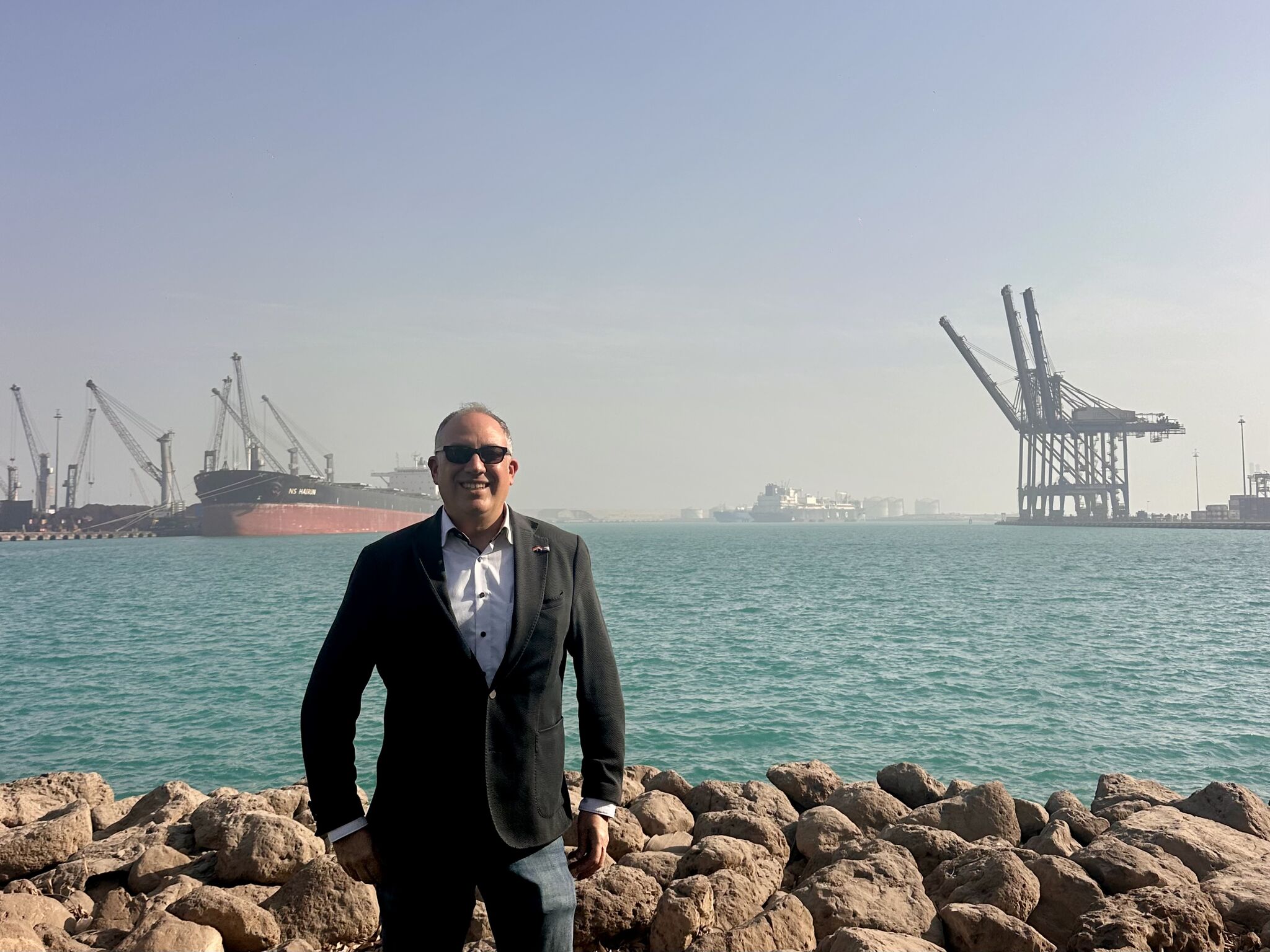
Yusef Ahmed helps international companies expand to the Suez Canal Economic Zone.