
The End of The World of Work – AS WE KNOW IT
Interview with Dr. David Bausch
Dr. David Bausch is an expert on digital changes in the world of work and their impact on employees. In February 2026, he published his book “The End of the World of Work as We Knew It”. In an interview with the Board Journal, he gives a brief outline on his findings from research and practice.
David, what does the end of the world of work as we knew it mean? What exactly is changing?
David Bausch: We are currently saying goodbye to a working world that had stability, predictability and a head start in knowledge as a model for success. In a time of AI disruption, a shortage of skilled workers and permanent crises, knowledge is rapidly losing value. Accordingly, the ability to learn, attitude and cooperation become decisive. Leadership is therefore shifting from control to orientation and psychological safety. Work is becoming less of a place with fixed rules and more of a dynamic system that must constantly evolve. In short, technology makes work more efficient, which is precisely why people are becoming a decisive competitive factor.
You write that organizational culture is always a mirror of our daily behavior. What does that mean?
David Bausch: Organizational culture is not created by mission statements, but by everyday actions. It manifests itself in meetings, decisions, feedback discussions or in how executives react to mistakes. If a company preaches “openness” but sanctions criticism, then the guiding principle is not the culture, but the behavior. Every email, every reaction, every decision sends a cultural signal, whether consciously or unconsciously. Culture is therefore never what organizations say, but always what they do every day.
In your book presentation, you said that organizations are falling back into old patterns in the current crisis phase – by creating more control and more complexity. How does this manifest itself in concrete terms in leadership behavior?
David Bausch: In uncertain times, many organizations react reflexively with more reporting, more coordination loops and longer decision-making paths. Executives protect themselves more strongly instead of distributing responsibility, thus creating a spiral of control that slows down organizations. Bureaucracy arises out of fear of making mistakes, although the ability to learn would actually be needed. This is precisely the paradox: the more complex the world becomes, the more organizations resort to instruments that make them even more immobile. Control provides short-term security, but in the long term it costs sustainability.
Companies must deliver measurable results, achieve profits and growth. Isn’t it a contradiction to let employees work uncontrollably and not keep up with their performance?
David Bausch: The opposite is the case: humanity is not a feel-good issue, but a productivity factor. Control often measures activity, but not effectiveness. Fake work looks productive, but it doesn’t create real value. Organizations with high psychological safety solve problems faster, innovate more, and lose fewer talents. Performance does not arise primarily from pressure, but from motivation, competence and clarity. Anyone who sees humanity as a luxury confuses short-term discipline with sustainable performance.
How do you measure the performance of employees in the future if you no longer control them? Are quantitative targets and target agreements still up to date? How do you pay fairly if there is no control of performance?
David Bausch: Quantitative targets are not disappearing, but they are no longer sufficient on their own. In complex work, the contribution to results, problem-solving skills and the ability to collaborate are increasingly important. Organizations need to do more to measure whether teams are learning, adapting, and developing future skills. Attendance time or pure output figures say little about sustainable value creation. In the future, performance will be defined less by control and more by effect in the system.
Many executives feel that they are losing control due to remote work. When employees are not in the office, they cannot see whether and what is being done. How do you lead successfully at a distance?
David Bausch: Remote work only shows a problem that already existed before: leadership based on visibility instead of trust. Successful distancing requires clearer goals, more conscious communication and stronger relationships than classic office management. Control through presence is replaced by clarity about responsibility and expectations. This does not make leadership less important, but more professional. Those who can lead remotely can usually lead better in general.
In your book you write that humanity is becoming important. At the same time, however, leadership is also becoming more and more digital. How can executives adapt to this “leadership paradox”, what exactly should they do to practice both humanity and digital leadership?
David Bausch: Digitization structures processes, but it does not replace relationships. The more work is digitized, the more important emotional intelligence, the ability to engage in dialogue and real spaces for conversation become. Executives must use technology to increase efficiency and at the same time consciously create time for orientation and humanity. Precisely because communication is becoming faster, trust needs more attention. The future of leadership is therefore not either digital or human, but necessarily both.
Artificial intelligence is likely to replace human work, especially with regard to repetitive and standardizable activities. What skills will executives need to have in the future when leading teams consisting of humans and machines? What is the modern type of leadership?
David Bausch: Specialist knowledge loses its half-life more quickly, which is why the ability to think, adaptability and system understanding become central. Executives must be able to moderate uncertainty instead of just controlling processes. The ability to create context, set priorities and enable learning becomes crucial. Modern leadership means less instruction and more design of framework conditions. If you want to lead teams of humans and AI, you must first and foremost understand how collaboration develops.
It is often said that when AI takes over human work, employees have more capacity for creative and higher-quality work. But does everyone really want to and can do that? How can executives develop their employees so that they actually develop their full potential?
David Bausch: The idea that everyone automatically works more creatively is naïve. Creativity does not come from free time, but from security, competence and learning spaces. Many employees first need orientation and development opportunities before they can develop their potential. Training alone is not enough, a real learning culture in everyday life is crucial. Leadership must therefore enable development, not just organize further education.
In the panel discussion at the book launch, it was said that in the past the principle of “Command & Control” applied, but today the enabler is in demand. What and how should the manager empower employees?
In the past, executives were primarily supposed to check that people do what was planned. Today, they have to enable people to deal with situations that cannot yet be planned. The “why” is therefore clear: Organizations need employees who can make independent decisions, learn and take responsibility, because markets react faster than hierarchies can decide.
The “how” does not begin with training, but with framework conditions: clear goals instead of micromanagement, psychological security instead of fear of mistakes, and real decision-making spaces instead of consent loops. Executives must provide orientation, clarify priorities and remove obstacles instead of prescribing solutions. Modern leadership therefore does not mean controlling people, it is much more important to make them capable of acting, even when the manager is not in the room.
What role does mental health of executives and employees play in the new world of work?
David Bausch: Mental health is not a social benefit or a corporate benefit, but the basis of performance. Overworked people learn worse, make worse decisions and innovate less. Leadership plays a key role in determining whether stress becomes visible or remains hidden. Organizations that promote psychological safety reduce absenteeism and increase retention. Health is therefore no longer a marginal issue, but an economic success factor.
The change in the world of work and the current economic crisis are leading to uncertainty and unpredictability. Many people feel insecure. At the same time, there is a certain “change fatigue”. How can executives deal with this: how do they convey more security and motivate them to actively embrace the change?
David Bausch: People don’t necessarily need stability, but they do need orientation. Leadership must explain why changes happen and what their purpose is. Small concrete steps have a stronger impact than large transformation programs. Transparent communication creates more trust than perfect strategies. People don’t follow change PowerPoints, they follow clarity, attitude and credible as well as authentic leadership.
Thank you very much for the interesting conversation.
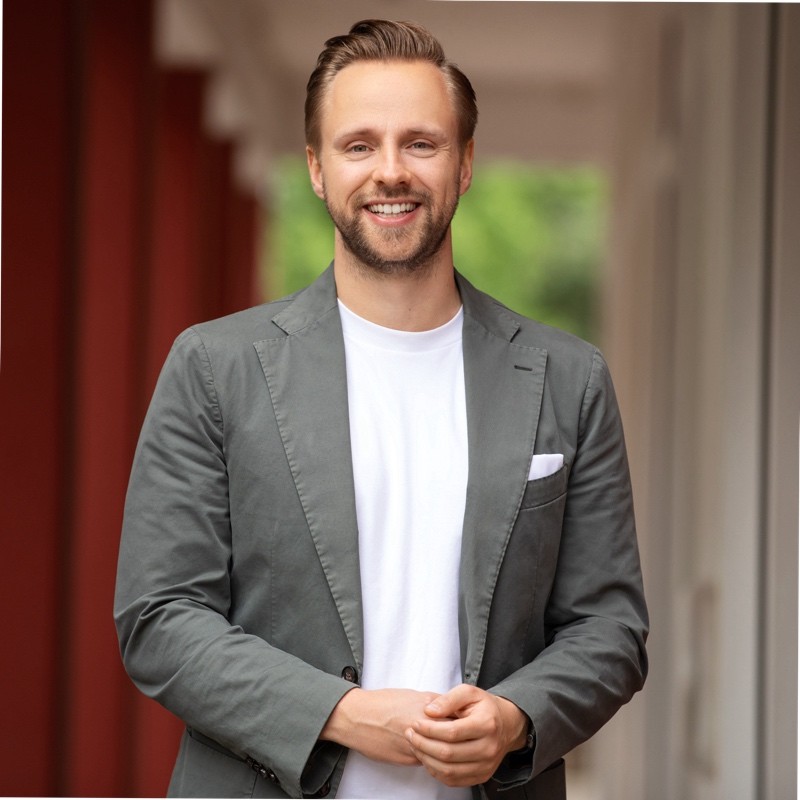
Dr. David Bausch holds a PhD in economics and social sciences, specializing in the digital transformation of the workplace and its impact on employees. His research, publications, and consulting work focus particularly on digital stress, mental strain, leadership behavior, and the organizational framework of modern work. Alongside his academic work, David is Deputy Head of Department at Commerzbank AG and has held various HR positions since 2016.