
What Venture Capital Investors Want to
Hear and See
Insights from Startupland 2026
What do venture capital investors look for when investing in young companies? The answers to this question are not only interesting for founders, but also offer insights for companies discussing investments with startups. At the Startupland Conference 2026 in Cologne, investors and consultants described what they want to hear and see.
When it comes to the initial presentation of a startup, the following types of pitches have become established in the market, as Johannes Dierkes from HighTechGründerfonds explained based on insights from Sequoia and Combinator:
➡ One-Sentence Pitch: briefly and concisely present the startup in a maximum of 10 seconds.
➡ Elevator Pitch: convincingly present the startup in a maximum of 30 to 90 seconds.
➡ Pitch Stage: focus on the startup’s solution and added value in three to seven minutes.
➡ Pitch Read: present the business in detail on 10 to 15 slides.
➡ Investor Pitch: Get to the point with your business model in 7+ minutes, focusing on facts.
As Johannes Dierkes emphasized, in addition to the founders, the entire team should be able to deliver the one-sentence pitch and elevator pitch. Based on his extensive experience, the perfect pitch deck is structured as follows:
➡ Title Page
➡ Problem
➡ Solution
➡ Traction
➡ Market Size and Competition
➡ Product
➡ Business Model/Vision
➡ Team
➡ Financial Ratios
➡ Questions and Use of Funds
Often, founders present their team and product at the beginning. However, it’s better and more advisable to start with the relevant problem and then present the solution. The goal is to demonstrate that a concrete pain point in the market has been identified and the resulting business potential recognized. Only then should the product be presented, along with how it solves the problem; this includes, for example, describing the target group and presenting a case study. Even though the founders play a crucial role for investors, the team should only be introduced in the final part of the presentation. After all, investors also need to know exactly how the raised funds will be used.
Johannes Dierkes also outlined typical mistakes startups make in their self-presentation. Often, the business model is presented in an overly complicated way, using convoluted sentences. For example: “Digital-electronics-enabled off-grid solution and neo energy provider for a decarbonized world.” A better approach would be: “Portable Batteries for Professionals.” Furthermore, presentations are often too factual and impersonal. It is advisable to specifically evoke emotions in investors through appropriate imagery and creative icons. This applies to both B2B and B2C business models. In addition, it is important to use the correct terminology from the world of investing.
Language is fundamental to a startup’s presentation – not just in terms of content. “How something is said is crucial. Not just on stage or in meetings, but also before and after,” emphasized Florian Kandler. There are two main “boxes” that investors categorize founders into:
➡ Desparation
➡ Opportunity
To land in the latter category, founders shouldn’t say, for example, “We need money for marketing and sales”—but rather, “We already have the following concrete business pipeline, and with fresh capital, we can now turn this pipeline into revenue.”
Furthermore, every perfect pitch creates an “aha moment” for investors by conveying an interesting new insight. It’s a good idea to quote the startup’s customers: recount the pain points they’ve shared with the founders—and then present the startup’s solution to those pain points.
Board Journal – March 22, 2026
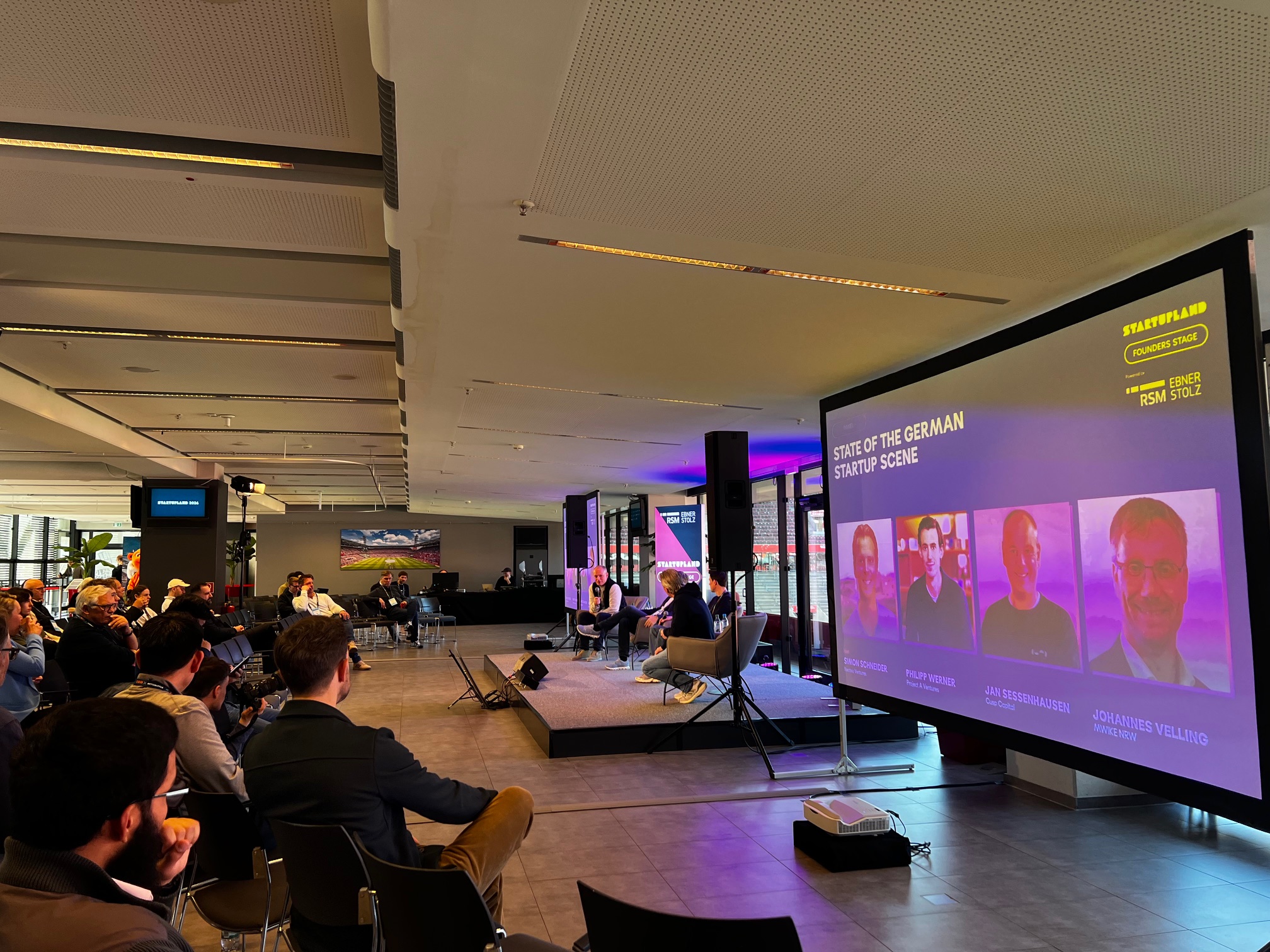
Founders and investors discussed about latest startup market trends in Germany during the Startupland Conference on 18 March 2026.